
Green List courses in New Zealand represent the most strategic educational pathway for international students seeking not just a world-class qualification but a fast-track route to New Zealand permanent residency. Introduced in 2022 and continuously updated through 2026, the New Zealand Green List identifies critical skill shortage occupations offering streamlined residence pathways, either immediate residency upon securing employment (Tier 1) or residency after two years of skilled work (Tier 2). For international students, choosing Green List courses means investing in qualifications that lead directly to high-demand careers with salaries ranging from NZD 60,000 to NZD 150,000 annually and guaranteed pathways to permanent settlement in one of the world’s most liveable countries.
As specialized education consultants and MARA-registered migration agents, Nepcoms guides international students through strategic course selection aligned with New Zealand’s Green List occupations, from diploma programs through bachelor’s and master’s degrees, ensuring your education investment maximizes both career outcomes and residency prospects.
What is the New Zealand Green List?
The New Zealand Green List is Immigration New Zealand’s official list of occupations experiencing acute skill shortages across the country. Unlike Australia’s skilled occupation lists, which primarily serve points-based skilled migration, New Zealand’s Green List provides direct, employer-supported residence pathways for workers in listed occupations who secure employment from accredited New Zealand employers.
The Green List replaced New Zealand’s previous Essential Skills in Demand lists, including the Immediate Skill Shortage List (ISSL), Regional Skill Shortage Lists (RSSL), and Long Term Skill Shortage List (LTSSL), consolidating them into one streamlined framework effective July 4, 2022, with ongoing updates through 2026.
Two-Tier Structure:
Tier 1: Straight to Residence Occupations on Tier 1 allows immediate residence visa applications upon securing full-time employment from an accredited New Zealand employer. No work-to-residence waiting period required; you can apply for permanent residency from day one of employment.
Tier 2: Work to Residence Tier 2 occupations require two years of skilled employment in New Zealand before becoming eligible to apply for residence. Experience counts from September 29, 2021, meaning existing work in these roles may count toward the two-year requirement.
Why Study Green List Courses in New Zealand?
Direct Pathway to New Zealand Residency
The primary advantage of Green List courses is the direct connection between qualification, employment, and residency. Upon completing a New Zealand qualification aligned with Green List occupations, graduates secure employment in their field and immediately access residence pathways, bypassing the uncertainty and points competition inherent in other skilled migration systems.
For Tier 1 occupations like Registered Nurse, Civil Engineer, or Software Engineer, securing employment means immediate eligibility for residence applications. For Tier 2 roles, the two-year work requirement is significantly shorter than traditional skilled migration waiting periods.
Post-Study Work Rights & Job Market Access
International students completing diploma programs (Level 5-6), bachelor’s degrees (Level 7), or postgraduate qualifications (Level 8-10) in New Zealand qualify for post-study work visas ranging from one to three years, depending on qualification level and study location. This critical period allows graduates to secure employment aligned with their Green List qualification, gain New Zealand work experience, and transition seamlessly to residence pathways.
New Zealand’s relatively small population (5.3 million) compared to its skill shortage needs means graduates face significantly less competition than in larger countries. Green List occupations experience genuine shortages; qualified graduates find employment quickly, often during their post-study work visa period.
Affordable Education with Strong ROI
New Zealand education costs significantly less than equivalent qualifications in the USA, UK, or Australia. Diploma programs cost NZD 15,000-25,000 per year, bachelor’s degrees range NZD 22,000-35,000 annually, and postgraduate qualifications cost NZD 26,000-45,000 per year, substantially lower than comparable programs in competing study destinations.
This affordability, combined with clear residence pathways, creates exceptional return on investment. Students recoup education costs within 2-3 years through New Zealand salaries while securing permanent residency rights, providing lifetime opportunities in a stable, high-quality-of-life country.
Top Green List Courses for Nursing & Healthcare
Healthcare represents the largest concentration of Green List occupations, with acute shortages across nursing, allied health, and medical professions driving continuous recruitment efforts.
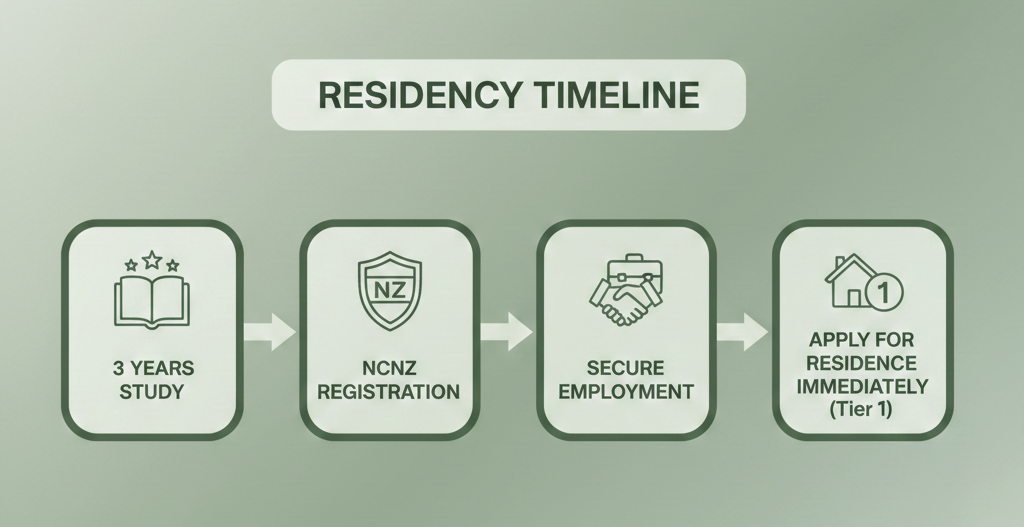
Bachelor of Nursing in New Zealand(Tier 1 – Straight to Residence)
Registered Nurse (ANZSCO 254411) is a Tier 1 Green List occupation, providing immediate residence eligibility upon registration and employment. All registered nurses, including aged care, medical, mental health, community health, and perioperative nursing specializations, qualify for fast-track residence, reflecting nationwide nursing shortages.
Program Details:
- Duration: 3 years full-time
- Annual Tuition: NZD 28,000-38,000
- Total Investment: NZD 84,000-114,000 (3 years)
Leading New Zealand Universities:
- Ara Institute of Canterbury
- Massey University
- Auckland University of Technology (AUT)
- Otago Polytechnic
- Eastern Institute of Technology
Registration Requirements: Graduates must register with the Nursing Council of New Zealand (NCNZ), requiring English proficiency (IELTS 7.0 all bands or equivalent) and successful completion of the Competence Assessment Programme (CAP) or direct NCNZ assessment.
Employment & Salary:
- Starting Salary: NZD 60,000-70,000 (base rate)
- Experienced RN: NZD 70,000-90,000
- Senior/Charge Nurse: NZD 85,000-110,000+
- Employment Rate: 98%+ within four months
Diploma of Nursing (Enrolled Nurse) (Tier 1)
Enrolled Nurse (ANZSCO 411411) also qualifies as Tier 1, providing a faster, more affordable pathway for students seeking nursing careers without committing to a full bachelor’s degree.
Program Details:
- Duration: 18 months to 2 years
- Annual Tuition: NZD 18,000-25,000
- Total Investment: NZD 27,000-50,000
Career Outcomes: Enrolled nurses work under the supervision of registered nurses in hospitals, aged care facilities, community health centers, and disability services, with strong employment outcomes and clear progression to registered nurse programs for ambitious graduates.
Starting Salary: NZD 50,000-62,000 annually
Allied Health Professions (Tier 1)
Multiple allied health professions qualify for Tier 1 fast-track residence, including Medical Laboratory Scientist, Medical Radiation Therapist, Radiographer, Sonographer, Occupational Therapist, and Physiotherapist.
These roles require bachelor’s or postgraduate qualifications with registration through relevant professional councils. Salaries range from NZD 60,000 to NZD 90,000 starting, increasing to NZD 90,000-120,000 with specialization and experience.
Engineering & Construction Green List Courses
Engineering professions represent another high-concentration Green List sector, with virtually all engineering disciplines qualifying for Tier 1 immediate residence pathways.
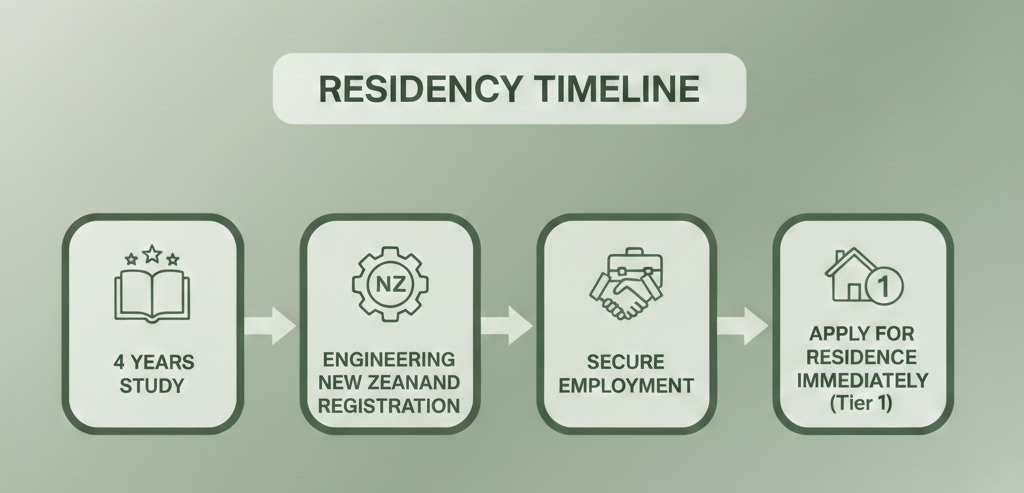
Bachelor of Engineering (Tier 1 – All Disciplines)
All major engineering disciplines qualify as Tier 1 Green List occupations, including Civil Engineer (233211), Mechanical Engineer (233512), Electrical Engineer (233311), Structural Engineer (233214), Geotechnical Engineer (233212), and Environmental Engineer (233915).
Program Details:
- Duration: 4 years (honours degree standard)
- Annual Tuition: NZD 28,000-40,000
- Total Investment: NZD 112,000-160,000
Leading Engineering Programs:
- University of Auckland (ranked top NZ engineering program)
- University of Canterbury (strong civil and mechanical)
- Victoria University of Wellington
- Massey University
- Auckland University of Technology (AUT)
Professional Recognition: Graduates should ensure programs are accredited by Engineering New Zealand (formerly IPENZ), providing Washington Accord recognition globally and streamlined registration pathways.
Employment & Salary:
- Graduate Engineer: NZD 60,000-75,000
- Engineer (3-5 years): NZD 85,000-110,000
- Senior Engineer: NZD 110,000-150,000+
- Principal/Lead Engineer: NZD 150,000-200,000+
Infrastructure Boom Context: New Zealand’s earthquake-resilient building requirements, infrastructure upgrades, and housing construction boom create sustained engineering demand. Major projects, including Wellington’s earthquake strengthening program, Auckland transport infrastructure, and Christchurch rebuild, ensure long-term engineering employment.
Construction & Quantity Surveying (Tier 1 & Tier 2)
Construction Project Manager (Tier 1) and Quantity Surveyor (Tier 1) offer clear residence pathways for graduates with construction management or quantity surveying qualifications.
Relevant Qualifications:
- Bachelor of Construction Management: NZD 25,000-35,000 per year (3-4 years)
- Bachelor of Quantity Surveying: NZD 26,000-36,000 per year (3 years)
- Postgraduate Diploma in Construction Management: NZD 30,000-40,000 (1 year)
Leading Institutions:
- Unitec Institute of Technology
- Auckland University of Technology
- Massey University
- Eastern Institute of Technology
Employment Outcomes:
- Graduate Quantity Surveyor: NZD 55,000-70,000
- Experienced QS: NZD 80,000-110,000
- Construction Project Manager: NZD 90,000-140,000+
IT & Technology Green List Courses New Zealand
Information and communications technology represents one of the fastest-growing Green List sectors, with over 10,000 technology worker shortages documented nationwide.
Software Engineering & Development (Tier 1)
Software Engineer (261313) and Developer Programmer (261312) are Tier 1 occupations with additional wage threshold requirements ensuring roles are genuinely specialist positions (typically NZD 80,000+ annual salary required).
Relevant Programs:
- Bachelor of Software Engineering: 4 years, NZD 28,000-38,000 annually
- Bachelor of Computer Science: 3 years, NZD 26,000-36,000 annually
- Postgraduate Diploma in Software Development: 1 year, NZD 30,000-42,000
Specializations Aligned with Green List:
- Cybersecurity (ICT Security Specialist – Tier 1)
- Cloud Architecture and DevOps
- Full-stack development
- Mobile application development
- AI and machine learning
Leading IT Programs:
- Victoria University of Wellington (Wellington = NZ’s tech capital)
- University of Auckland
- Auckland University of Technology
- Waikato University
- Massey University
Employment & Salary:
- Junior Developer: NZD 60,000-75,000
- Mid-level Developer: NZD 80,000-105,000
- Senior Developer/Engineer: NZD 110,000-140,000+
- Lead/Principal Engineer: NZD 140,000-180,000+
Tech Sector Context: Wellington’s concentration of tech companies (including Weta Digital, Xero, and numerous startups) creates exceptional employment opportunities. Auckland’s growing fintech and enterprise software sectors provide diverse career pathways.
ICT Management & Specialist Roles (Tier 1)
Chief Information Officer (135111), ICT Project Manager (135112), Database Administrator (262111), and ICT Security Specialist (262112) all qualify as Tier 1 with high wage thresholds reflecting senior/specialist positioning.
Relevant Qualifications:
- Master of Information Technology: 1.5-2 years, NZD 30,000-45,000 per year
- Postgraduate Diploma in IT Management: 1 year, NZD 32,000-42,000
- Master of Cybersecurity: 1-2 years, NZD 32,000-46,000
Graduates with bachelor’s degrees in IT, engineering, or related fields can pursue postgraduate IT qualifications, providing direct pathways to specialist roles commanding premium salaries and immediate residence eligibility.
Teaching & Education Green List Courses
Teaching represents a significant Green List sector, particularly for secondary teachers in specific subject areas and primary teachers facing nationwide shortages.
Bachelor of Teaching (Primary) & Secondary Teaching (Tier 1 & Tier 2)
Primary Teacher (Tier 1) and Secondary Teacher in specific subjects (Tier 1 for Sciences, Maths, Te Reo Māori) provide clear pathways for education graduates.
Program Options:
- Bachelor of Teaching (Primary): 3 years, NZD 22,000-30,000 annually
- Bachelor of Teaching (Secondary): 3 years, NZD 22,000-30,000 annually
- Postgraduate Diploma in Teaching: 1-year graduate-entry program, NZD 24,000-32,000
Registration Requirement: Teaching Council of New Zealand registration is mandatory, requiring approved qualifications and English proficiency.
Employment & Salary:
- Beginning Teacher: NZD 55,000-62,000 (Step 1-3)
- Experienced Teacher: NZD 70,000-85,000 (Step 7-12)
- Senior Teacher: NZD 90,000-105,000+
2026 Update: Teachers on the Skilled Residence pathway must now reach Step 5 of the pay scale to remain eligible (increased from Step 4), affecting salary requirements for residence applications.
Trade & Technical Green List Courses
Trade qualifications represent an often-overlooked pathway to New Zealand residence, with multiple skilled trades featuring on the Green List Tier 2.
Electrician, Plumber & Trade Qualifications
Electrician (General) (341111) and Plumber (General) (334111) qualify as Tier 2 occupations, requiring two years of work before residence eligibility but offering exceptional employment outcomes.
Qualification Pathway:
- New Zealand Certificate in Electrical Engineering (Trade): Level 4, 1-2 years, NZD 8,000-15,000
- New Zealand Certificate in Plumbing and Gasfitting: Level 4, 1-2 years, NZD 8,000-15,000
Trade qualifications combine classroom learning with work-based apprenticeship, providing immediate earning capacity while studying.
Employment & Salary:
- Apprentice Electrician: NZD 25,000-45,000
- Qualified Electrician: NZD 60,000-80,000
- Experienced/Specialist: NZD 85,000-110,000+
Residency Timeline: 1-2 years qualification → 2 years work in trade → Apply for residence (Tier 2)
Automotive & Diesel Mechanics (Tier 2)
Automotive Electrician and Diesel Motor Mechanic qualify as Tier 2, reflecting transport industry skill shortages nationwide.
Programs:
- New Zealand Certificate in Automotive Electrical Engineering: Level 4, 1-2 years
- New Zealand Certificate in Heavy Automotive Engineering: Level 4, 1-2 years
Tuition: NZD 8,000-16,000 per year
Application Requirements for Green List Courses
Academic Entry Requirements
For Bachelor’s Degrees:
- Completion of higher secondary education (12th grade equivalent)
- Minimum academic performance varies by program (typically 60-70% overall)
- Mathematics prerequisites for engineering, IT, and sciences
- Biology/chemistry prerequisites for health sciences
For Postgraduate Programs:
- Relevant bachelor’s degree with minimum GPA (typically 5.0/9.0 or B average)
- Work experience is preferred but not mandatory for most programs
- Professional registration is required for some health/teaching programs
English Proficiency Requirements
Standard Requirements:
- IELTS Academic: Overall 6.0 (no band less than 5.5-6.0 depending on program)
- PTE Academic: Overall 50-58+
- TOEFL iBT: Overall 60-79+
Higher Requirements (Nursing, Teaching):
- IELTS Academic: Overall 7.0 (all bands 7.0 for nursing registration)
- PTE Academic: Overall 65-73+
Achieving higher English scores accelerates professional registration and improves employment prospects significantly.
Student Visa Requirements
International students applying for New Zealand student visas must demonstrate a genuine intention to study, financial capacity covering tuition and living expenses (NZD 20,000 per year), acceptable health and character standards, and Overseas Student Health Cover for the visa duration.
Living Expenses Requirement: NZD 20,000 per year (government minimum)
Work Rights: Student visa holders can work up to 20 hours per week during the semester and full-time during scheduled breaks, helping offset living costs while building New Zealand work experience.
Green List Residency Application Process
Step 1: Complete Qualification & Secure Employment
Graduated with a New Zealand qualification aligned with the Green List occupation. Secure a full-time job offer from an accredited New Zealand employer in a Green List occupation matching your qualification.
Step 2: Meet Occupation-Specific Requirements
Ensure professional registration if required (nurses, teachers, engineers, health professionals). Verify salary meets minimum wage thresholds for occupation (many Tier 1 IT roles require NZD 80,000+ annually). Confirm the employer holds Accredited Employer status through Immigration New Zealand.
Step 3: Lodge Residence Application
Tier 1 (Straight to Residence): Apply immediately upon securing employment
Tier 2 (Work to Residence): Work in an occupation for two years, then apply
Application Requirements:
- Job offer letter detailing role, salary, terms
- Employment agreement
- Evidence of meeting occupation requirements
- Professional registration certificates
- English proficiency evidence (IELTS 5.0 minimum for partner/dependent English requirements)
- Health and character certificates
- Age under 56 years
Application Fee: NZD 4,000-5,000 depending on application type
Processing Time: 6-12 months from complete application
Why Choose Nepcoms for New Zealand Green List Courses
Navigating New Zealand’s education system and Green List residence pathways requires strategic course selection, understanding occupation requirements, and professional guidance ensuring your study investment aligns with long-term settlement goals.
As specialized education and migration consultants with expert visa services, Nepcoms provides free Green List course assessment and pathway planning, university and program selection maximizing residence prospects, scholarship identification and applications, complete student visa application and documentation, English test preparation guidance for required proficiency levels, and residency application support upon graduation.
Frequently Asked Questions
What is the difference between Tier 1 and Tier 2 Green List?
Tier 1 allows immediate residence application upon securing employment. Tier 2 requires two years of work in New Zealand before residence eligibility.
Q: Can I apply for Green List residence from outside New Zealand? You must secure employment from an accredited New Zealand employer and typically need to be in New Zealand on an appropriate work visa when applying for residence.
Do all nursing graduates qualify for Tier 1 residence?
Yes, all Registered Nurses (including specializations) qualify for Tier 1 upon NCNZ registration and employment. Enrolled Nurses also qualify for Tier 1.
How long is the post-study work visa in New Zealand?
Diplomas (Level 5-6): 1 year; Bachelor’s degrees (Level 7): 3 years; Postgraduate qualifications (Level 8-10): 3 years, depending on study location.
Are IT courses on the Green List in New Zealand?
Yes, Software Engineer, Developer Programmer, ICT Security Specialist, Database Administrator, and ICT management roles are Tier 1 occupations with wage thresholds.
What happens if my occupation is removed from the Green List?
Immigration New Zealand provides transition periods. Existing work visa and residence applications in progress usually continue processing. Future updates focus on adding roles rather than removing existing ones.
Can my family join me on a Green List residence visa?
Yes, partners and dependent children can be included in residence applications, subject to English proficiency requirements (IELTS 5.0 minimum for partners).
How much does studying Green List courses cost in New Zealand?
Diplomas: NZD 15,000-25,000 per year; Bachelor’s degrees: NZD 22,000-40,000 per year; Postgraduate: NZD 26,000-46,000 per year, depending on institution and program.
Start Your New Zealand Green List Journey with Nepcoms
Choosing Green List courses in New Zealand provides the most direct pathway from international student to permanent resident, combining quality education with guaranteed career opportunities and streamlined residence processes.
Ready to secure your New Zealand future?
📧 Email: ktm@nepcoms.com
📞 Phone: 9801292944
Book your free Green List consultation today and let our education and migration experts develop your personalized pathway to New Zealand permanent residency through strategic course selection.