
IELTS Course in Kathmandu
Two morning sessions, 8:30 to 9:30 and 9:30 to 10:30, Sunday to Friday. Four weeks, Academic and General Training, taught on computer because that is how the test is now delivered. Join any working day. We run no batches, so there is nothing to wait for.
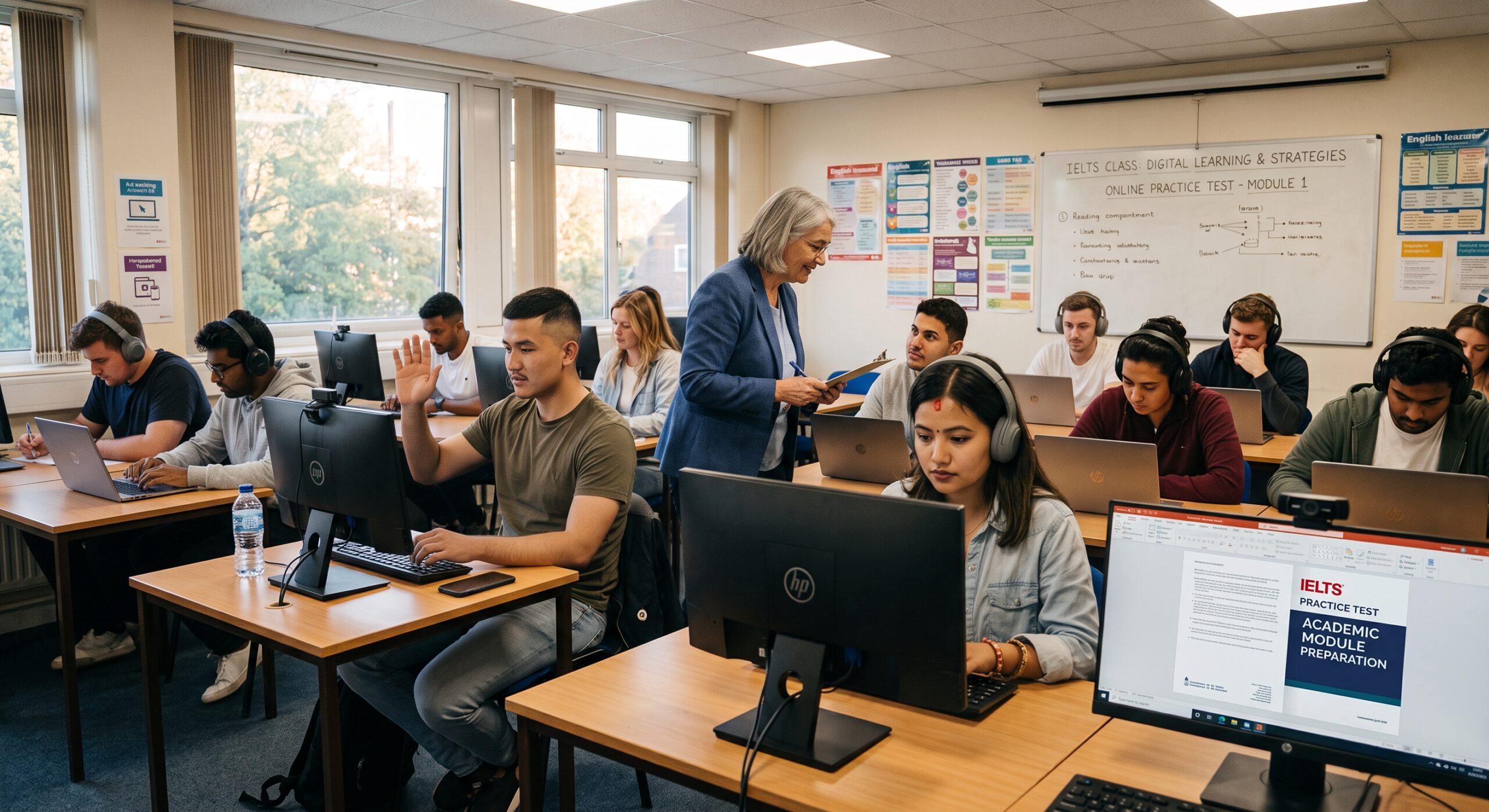
Comprehensive Course Modules
Every hour of this IELTS course in Kathmandu is spent on one of the four scored modules or on a mock. There is no general English filler.
Listening
Forty questions, four sections, one hearing only. We train prediction, spelling under pressure and the full accent range: British, Australian and North American.
30 minutesReading
Forty questions in sixty minutes. Timing is what fails people, not vocabulary. True/False/Not Given and matching headings get the most drill time.
60 minutesWriting
Task 1 and Task 2, marked against the four public band descriptors. Work comes back annotated, not just given a number.
60 minutesSpeaking
Three parts with a live examiner. Every IELTS class morning session closes with speaking practice, and week four adds a recorded one to one mock.
11 to 14 minutesWhy Prepare with Nepcoms?
This IELTS course in Kathmandu is run by a consultancy, not a language school: an eighteenth year placing Nepali students abroad, with offices in Nepal and Australia. Preparation and application run in the same building, which is why our students rarely miss an intake waiting for a score.
In our 18th year
Trainers who have sat the test and counsellors who read the offer letters it feeds.
Computer based practice
Week four is taught on screen, because paper delivery is being retired worldwide.
Writing marked by a person
Annotated feedback against the four band descriptors, returned inside the IELTS class morning session, not an automated score.
No batches, ever
A rolling cycle, so the IELTS course duration starts the day you do. Join on a Sunday or a Wednesday; you still cover all four modules.
Class timings
Mornings only. Pick a slot when you enrol and switch later at no cost.
Early slot
Best if college or the office starts at ten or eleven. The quieter of the two, and the smaller IELTS class morning session.
Open, join any daySecond slot
Best if you commute from outside the Ring Road, or finish a night shift.
Open, join any dayBoth slots run the identical syllabus, Sunday to Friday, with the same trainer standard and the same materials. We do not run afternoon or evening classes.
IELTS course duration: how long it actually takes
It is the first question everyone asks about an IELTS course in Kathmandu, and the honest answer is four weeks of taught classes, then as long as your band score needs.
Four weeks at one hour a day, six days a week, is roughly 24 taught hours. That is enough to cover every question type in all four modules, sit mock tests, and get your writing marked more than once.
| Week | What you cover | Hours |
|---|---|---|
| Week 1 | Diagnostic test, band target, Listening sections 1 to 4, Reading skimming and scanning | 6 |
| Week 2 | Writing Task 1 for both modules, Reading question types, Speaking Part 1 | 6 |
| Week 3 | Writing Task 2 essay structures, Listening accents and traps, Speaking Parts 2 and 3 | 6 |
| Week 4 | Full timed mock, marked writing, one to one speaking feedback, computer practice | 6 |
| Standard IELTS course duration | Four weeks, Sunday to Friday | ~24 |
Where competitors quote six or eight weeks, they are usually padding a timetable to fill a batch. Four focused weeks plus honest feedback beats eight unfocused ones. But the IELTS course duration that matters is the one your band score needs, so if you are not ready at the end of week four you repeat the cycle at no extra charge. A student starting at band 4.5 will normally need eight to ten weeks to reach 6.5; a student already at 6.0 often needs three.
Two things shorten the IELTS course duration more than anything a trainer can do: attending all six days rather than three, and doing the daily homework. Two things lengthen it: booking the test before you are ready, and skipping speaking practice because it is uncomfortable. No IELTS course in Kathmandu can change either of those for you.
IELTS is now a computer test, and most preparation in Nepal has not caught up
From mid 2026 the test partners, British Council, IDP and Cambridge, are retiring paper based IELTS worldwide and moving delivery onto computer. Results already issued on paper stay valid for their full two years. But if you are booking a test now you are almost certainly booking a computer test, and preparing on paper worksheets alone will cost you marks that have nothing to do with your English. It is the single best question to put to any IELTS course in Kathmandu before you pay: where do your students practise, on paper or on screen?
No transfer time in Listening
On paper you got 10 minutes at the end to copy answers onto the answer sheet. On computer you get 2 minutes to check. You type as you listen, or you lose the answer.
An on screen clock
Reading and Writing are 60 minutes each with a timer that flashes at 10 and 5 minutes remaining. Useful, and distracting, if you have never seen it before.
One Skill Retake
Sit a full computer test in Kathmandu, Pokhara or Chitwan and you may retake a single weak module within 60 days instead of all four.
- Week four of this IELTS course in Kathmandu is spent on screen, not on paper, so the interface is familiar before test day.
- We drill typing speed for Writing, because the word counter in the corner is the only place your essay length is visible.
- Speaking is unchanged: still eleven to fourteen minutes with a real examiner, not a machine.
- If an institute is still advertising paper practice tests as its main method in 2026, ask them why.
IELTS Test Format
Understanding the structure of the exam is the first step towards success, and it is what the first three weeks of the IELTS course in Kathmandu are built around. Here is a breakdown of the four modules as they are delivered on computer.
Listening
Duration: 30 minutes, plus 2 minutes to check your answers. There is no 10-minute transfer time on computer.
40 questions across four recorded sections, from a monologue to a group conversation. You hear each recording once.
Reading
Duration: 60 minutes, with no extra time to transfer answers.
40 questions on three long texts. Academic uses journal and book extracts; General Training uses notices, handbooks and advertisements.
Writing
Duration: 60 minutes for both tasks, with a live word count on screen.
Task 1 is 150 words: a chart or process for Academic, a letter for General Training. Task 2 is a 250-word essay and carries twice the marks.
Speaking
Duration: 11 to 14 minutes, face to face with a real examiner.
Three parts: an introduction and familiar questions, a long turn from a task card, and a two way discussion of abstract ideas. Identical for both modules, and drilled in every IELTS class morning session.
Academic and General Training share the same Listening and Speaking papers. Only Reading and Writing Task 1 differ, which is why both streams sit in one class here.
Band Score & Assessment Criteria
IELTS results are reported on a 9-band scale. You get a score for each of the four modules and an overall band, rounded to the nearest whole or half band. Week one of the IELTS course in Kathmandu starts by fixing the number you actually need. Nothing is a pass or a fail. The institution you are applying to sets the number it will accept, and results stay valid for two years.
The 9-band scale
- Band 9 Expert user
- Band 8 Very good user
- Band 7 Good user
- Band 6 Competent user
- Band 5 Modest user
- Band 4 Limited user
Most undergraduate programmes in Australia and New Zealand ask for an overall 6.0 to 6.5 with no band below 5.5 or 6.0. Master’s courses commonly ask 6.5, and nursing, teaching and professional registration often 7.0 in every band. Bring your shortlist to counselling and we will give you the exact number rather than a general one.
Marking Criteria
Writing and Speaking are marked by a human examiner against four public descriptors, each worth a quarter of the module score. Knowing them is most of the work.
Fluency and coherence
Speaking at a natural pace, without long pauses, and ordering ideas so an examiner can follow them.
Lexical resource
Range and accuracy of vocabulary. Precision beats memorised idioms dropped in the wrong place.
Grammatical range and accuracy
Correct use of a variety of structures. One clean complex sentence is worth more than three broken ones.
Pronunciation
Clarity of sounds, stress and intonation. A Nepali accent is not a penalty; being hard to follow is.
In Writing, the fourth criterion is Task Achievement or Task Response rather than pronunciation, meaning whether you actually answered the question asked. It is the most common reason a strong essay scores a 6.
Academic or General Training, and which one you need
This IELTS course in Kathmandu prepares both, in the same room. Choosing the wrong module is an expensive mistake, so we settle it in week one.
Take Academic if
- You are applying to a university or college abroad, at any level
- You need professional registration in nursing, medicine or engineering
- Your Writing Task 1 will be a chart, graph, table, map or process diagram
- You are heading to Australia, New Zealand, the UK, Canada or Dubai to study
Take General Training if
- You are applying for permanent residence or a skilled migration visa
- You are going abroad for work rather than study
- Your Writing Task 1 will be a letter, formal or informal
- Your Reading passages come from notices and handbooks rather than journals
If you need the test for a UK visa, check whether the institution requires IELTS for UKVI, a separately booked and more expensive version of the same test. Booking the wrong one means paying twice. Our counselling team confirms the exact requirement before you pay any test fee.
Who this IELTS course in Kathmandu is for
A morning only class rules some people out by design. Here is the plain version, so you can disqualify yourself in thirty seconds rather than after four weeks.
A good fit
- You can commit to one hour every morning, six days a week, for the full IELTS course duration
- You need a band between 5.5 and 7.5 and have basic working English already
- You want your writing marked by a person, not a score generator
- You are applying through Nepcoms and want preparation and application in one place
Not a good fit
- You can only study in the evening. We do not run evening classes and will not pretend otherwise
- Your English is at absolute beginner level. Build a foundation first, then come back
- You want a guaranteed band score. Nobody can honestly promise one, and anyone who does is selling
- Your test is in nine days. Take it, see the real score, then prepare properly
How to join, any day of the week
Unlike most providers of an IELTS course in Kathmandu, there is no waiting list and no next batch date. The syllabus is a rolling four week cycle.
- 1
Tell us your target and your deadline
Fill the form on this page or call the office. We need your target band, the country you are applying to, and the date you would like to sit the test.
- 2
Sit a free diagnostic test
About ninety minutes covering Listening, Reading and a writing sample, sat outside the IELTS class morning session. It tells us your starting band honestly, which is more useful than flattering.
- 3
Pick your slot
8:30 to 9:30 or 9:30 to 10:30. Your IELTS class morning session is confirmed on the spot, and you can change it later at no cost.
- 4
Start the next working day
No batch to wait for. You join the rolling cycle wherever it is that week and complete the full IELTS course duration from there.
- 5
Book the test only when your mock says so
We will tell you when your mock scores are consistently at or above target. Booking early is the most common and most expensive mistake in Nepali IELTS preparation.
What the IELTS test itself costs in Nepal
The fee for the IELTS course in Kathmandu is confirmed at counselling. What we can publish is the test fee, which is not paid to us.
You pay the test fee directly to IDP or the British Council when you book. As of September 2026 the computer delivered test is around NPR 36,000, and the UKVI versions cost more.
| Test | Fee (NPR) | Notes |
|---|---|---|
| IELTS on computer, Academic or General Training | ~36,000 | Results in a few days |
| IELTS for UKVI on computer | ~36,400 | Only if your UK visa route requires it |
| IELTS for UKVI on paper | ~39,600 | Being withdrawn with paper delivery |
| Life Skills A1 / B1 | ~29,000 | Family and spouse visa routes |
| One Skill Retake | Ask the centre | Within 60 days, computer tests only |
Figures last checked on 1 September 2026 against IDP Nepal’s published fee list; the fee for the IELTS course in Kathmandu itself is quoted at counselling, once your diagnostic shows whether four weeks will be enough. Put the two costs side by side and the arithmetic is simple: a retake costs more than a month of tuition. That is the whole argument for preparing before you book.
Frequently asked questions
IELTS course duration, morning timings, fees and the 2026 format change, answered plainly.
What is the IELTS course duration at Nepcoms?
What are the IELTS class morning session timings?
How much does an IELTS course in Kathmandu cost?
Do I have to wait for a batch to start?
Do you teach IELTS Academic or General Training?
How much does the IELTS test cost in Nepal?
Is IELTS still available on paper in Nepal?
What is One Skill Retake and can I use it in Nepal?
How long is an IELTS score valid?
Which band score do I actually need?
Do you offer a trial class before I pay?
Can I prepare for IELTS while applying through Nepcoms?
Book a free diagnostic test and start tomorrow morning
An IELTS course in Kathmandu is worth choosing on the quality of the feedback, not the length of the timetable. Come in for the free diagnostic, meet the trainer, sit in on a class, and decide afterwards. There is no batch date to catch and no obligation to enrol, and the IELTS course duration extends free of charge until your mock scores hold at your target band.
Related Nepcoms pages
Everything that sits either side of an IELTS course in Kathmandu, from the other English tests to the destinations your score unlocks.
Know your band target already? Start with the destination.